Why donate to MHAF and how-to online or by check
I’ve been thinking about ways that people generously support the work of Mental Health America of Fredericksburg (MHAF). It seems a good idea to start listing them so that you can see what fits your situation. Of course, we all want to help as we can. Several years ago my wife and I decided to put the majority of our support into local programs and institutions or ones that we could verify were effective. It turned out for us, that MHAF meets both those criteria. The proceeds from every event and campaign support programs in our area. MHAF also has a great track record in working with the people it serves and with other organizations to educate, advocate, and implement cooperative programs.
#1. Direct donations online. This past year MAHF has set up a way that you can easily donate online to MHAF. Just go to http://mhafred.org/donate, pick the amount of your donation and follow the prompts. You can also designate a specific program – Senior Visitors, HelpLine, Suicide Prevention Education, Support Groups – for a donation and/or make the donation in honor of someone else. You also have the opportunity to pay the processing fee ( 3% ) MHAF has to pay to process a credit card transaction.
#2. Direct donation via check. Some people prefer to send their donation as a check to the MHAF Office. When you want to do that, make the check out to MHAF and mail it to
Mental Health America of Fredericksburg
2217 Princess Anne Street, Suite 104-1
Fredericksburg, VA 22401
Thank you!
What is #GivingTuesday?
#GivingTuesday is a global giving movement that has been built by individuals, families, organizations, businesses, and communities in all 50 states and in the countries around the world. Millions of people have come together to support and champion the causes they believe in and the communities in which they live.
We have two days for getting deals- Black Friday and Cyber Monday. On #GivingTuesday, we have a day for giving back. Together, people are creating a new ritual for our annual calendar. #GivingTuesday is the opening day of the giving season: a reminder of the “reason for the season.”
This year, Mental Health America of Fredericksburg is using all #GivingTuesday donations to fund a series of our Teen Support Group. By donating on #GivingTuesday you will be providing a young person with the opportunity to improve their life.
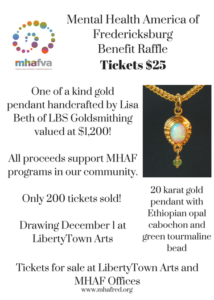
MHAF Benefit Art Raffle
Announcing the third annual benefit raffle for Mental Health America of Fredericksburg. Each year we work with a local artist to develop an item for the raffle. This year we raffle a gorgeous piece of jewelry by Lisa Beth Goldsmithing. All proceeds go to MHAF programs in our community. Only 200 tickets to be sold at $25 each. Tickets can be purchased at LibertyTown Arts, Lisa Beth’s Studio in LibertyTown, MHAF offices and from MHAF board members. If you want to make a purchase via credit card please get in touch with ernestackermann@mhafred.org.
Another Day Poker Run, Sept 9, 2017
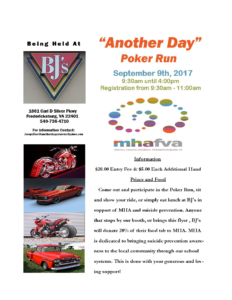 September 9, 2017, 9:30 AM to 4:00 PM. Registration fro 9:30 AM to 11:00AM
$20.00 entry fee & $5.00 each additional hand
Come out to BJ’s in Central Park, 1861 Carl D Silver Pkwy, and participate in the Poker Run, sit and show your ride, or simply eat lunch at BJ’s in support of MHA and suicide prevention. For anyone who stops by our booth, or brings the flyer shown here, BJ’s will donate 20% of their food tab to MHAF. MHAF is dedicated to bringing suicide prevention awareness to the local community through our school systems. THis is done with your generous and loving support.
Social Media’s Impact on Young People’s Mental Health is Real
From the American Association of Suicidology (AAS) – suicidology.org
Many media outlets are reporting on the “Blue Whale Challenge,” a social media game that allegedly encourages young people to engage in self-harm and suicidal behavior. While we have no evidence the Blue Whale Challenge is a real phenomenon, we do know that social media—in all forms—can have a significant impact on mental health, especially for young people.
Youth are among the highest-risk groups for suicide: according to the CDC, 17% of grade 9-12 students reported seriously considering suicide in the past 12 months. We urge parents and educators to sit down with children and youth and talk about social media’s potential impact. Kidshealth.org provides useful guidelines for having these conversations. It’s essential to talk openly and honestly about mental health, depression, and thoughts of suicide—and whether social media use might be a contributing factor. While many discussions hinge on the negative effects of social media, its positive impact cannot be ignored: social media can be helpful for people who are suicidal and unable to reach out in person.
Youth struggling with thoughts of suicide usually present with warning signs. In young people, these warning signs might be seen as talking about death or hopelessness, extreme irritability, pulling away from friends and family, and loss of enjoyment in their usual activities. If you notice warning signs, reaching out quickly and talking openly about suicide can help save a life.
AAS President Julie Cerel says, “Anytime a child dies by suicide, we search for the reason why. Suicide is complicated and never has a single cause. By implicating events like the Blue Whale Challenge as the cause of youth suicide, we risk minimizing someone’s emotional pain and further discriminating against those who are suffering.”
Resources available for support:
National Suicide Prevention Lifeline – 800-273-8255
Crisis Text Line – Text HOME to 741 741
For the media: We urge members of the media to be cautious in reporting on stories about the Blue Whale Challenge and similar events. These news items can become viral “urban legends” and contribute to a culture of fear and alarm that makes suicide and social media harder to talk about for youth, parents, and educators.
Responsible reporting on suicide, and the inclusion of stories of hope and resilience, can prevent more suicides. For more information on safe messaging around suicide, click here.
###
About AAS: Founded in 1968 by Edwin S. Shneidman, PhD, AAS promotes suicide as a research discipline, public awareness programs, public education and training for professionals and volunteers. The membership of AAS includes mental health and public health professionals, researchers, suicide prevention and crisis intervention centers, school districts, crisis center volunteers, survivors of suicide loss, attempt survivors, and a variety of lay persons who have in interest in suicide prevention. You can learn more about AAS at suicidology.org